Larry The Cucumber in a band [OLD]
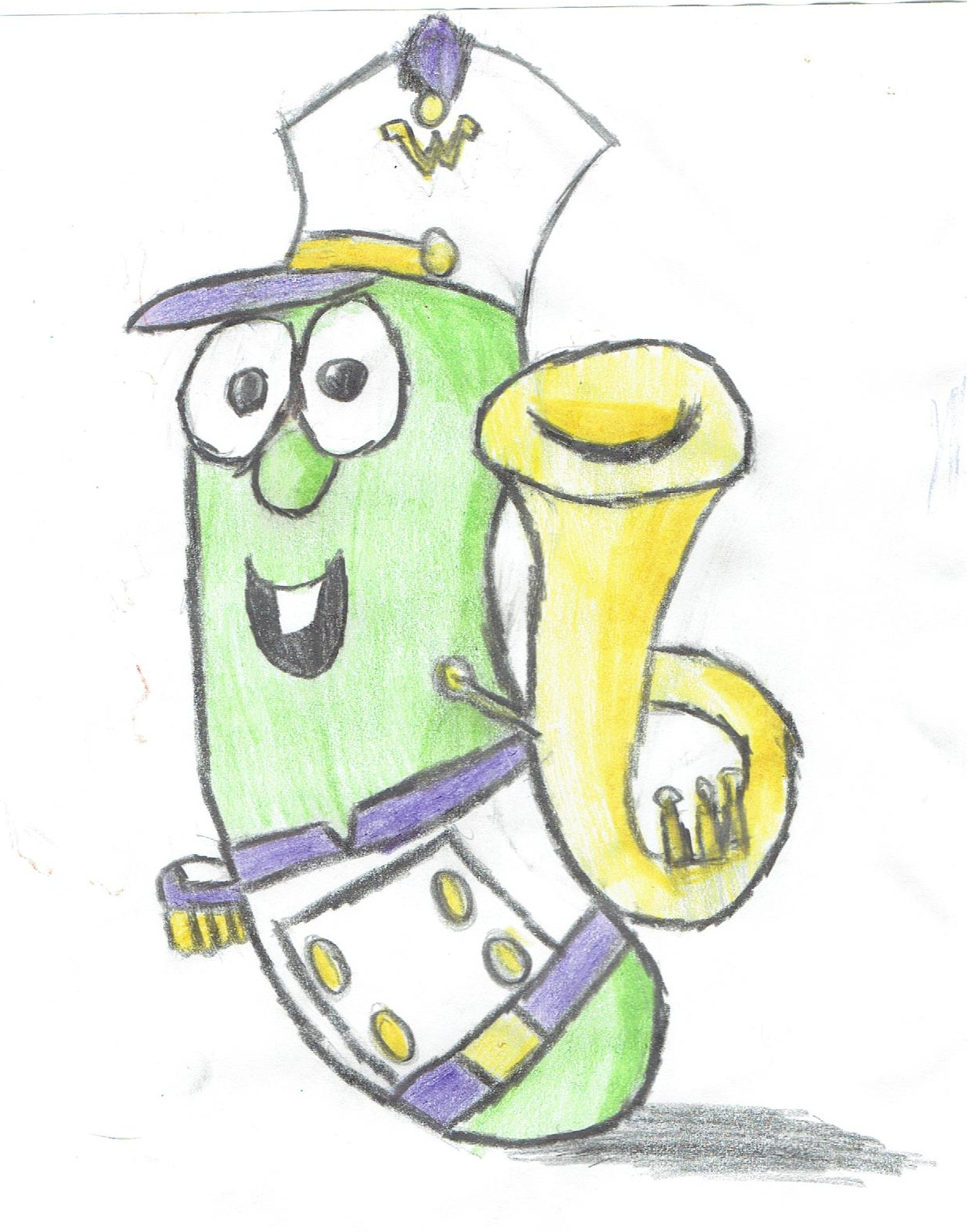
If you grew up during the late 90s or early 2000s, you are likely familiar with the world of VeggieTales. Yes that world of talking Christian produce going on biblical inspired adventures to teach us a biblical lessons. Along with all that I woundered why all these vegetables were talking and where they even were: were they going to be eaten since they were in a kitchen? Who knows!
Anyway, among these living colorful veggies was the loyal yet lovable cohost Larry the Cucumber he has always been a standout favorite. This specific piece, titled "Larry the Cucumber in a Band," was an early practice drawing of mine from the 2006–2007 period.
Larry among many things is known for his "Silly Songs" and his endearing, sweet personality. As a fan of the classic series, I wanted to capture his likeness using a tutorial I had found at the time. In the mid-2000s, before YouTube became the giant it is today, many artists relied on printed step-by-step guides or simple web tutorials to learn the fundamentals of character design. This drawing was my attempt to master the "bean" shape and large, expressive eyes that make Larry so iconic. Every artist has a story behind their work, but the story behind this Larry drawing is a bit different. While I was drawing, my younger (and admittedly less artistic) nephew was also sketching beside me. In a moment of competitive spirit, I decided to turn the session into a "challenge." I wanted to "beat" him by producing the superior drawing, showing off my technical skills.
This shift in mindset-from drawing for pleasure to drawing to "win"-changed the entire energy of the session. While my nephew was scribbling away and having a blast, I became hyper-focused on every stroke of my #2 pencil every color of my crayons: I wanted the lines to be perfect, the curves of the cucumber to be seamless, and the colors of the crayons to be perfectly blended within the lines.
Ironically, even though the final product was technically "better" than my nephew’s, I realized something important: I had much less fun making it and even my mom noticed.
Because I was soo worried about "beating" someone else, I got stressed over every single imperfection. If a line was slightly crooked or a crayon shade was too dark, I felt a sense of frustration rather than the joy of my new creation like all the others. My nephew, on the other hand, was laughing and enjoying drawing, completely unbothered by perfection and "technical accuracy."
This drawing became a turning point in my artistic philosophy. I realized that I had missed the entire point of the exercise. Art is supposed to be a form of expression and practice, not a high-stakes competition. After this piece was finished, I made a conscious decision: I wouldn't take my drawings so seriously anymore. This "Big Grin" lesson has stayed with me for over two decades. Despite the stress involved in creating it, the technical side of "Larry in a Band" is a great look at mid-2000s art.
1. The Medium: Using white printing paper provided a smooth surface, but it didn't allow for much layering. Every mark with the #2 pencil had to be intentional, as erasing too much on thin printer paper can lead to smudges or even tears.
2.Coloring with Purpose: Using crayons to color a character like Larry is actually harder than it looks! To get that solid "cucumber green," I had to use consistent pressure.
3.Character Anatomy: Larry the Cucumber is deceptively simple. He has no arms or legs (usually playing instruments through "veggie magic" or telekinesis or whatever), so the focus has to be entirely on his facial expressions and his bounce. For any artist visiting this gallery, "Larry the Cucumber" serves as a reminder that practice is a double-edged sword. It is essential to follow tutorials and learn the rules of character design, but you must never lose the "play" in the process.
We all want help getting better and the most helpful advice I can give through this piece is this: Don't let your ego kill your creativity. If you find yourself getting stressed about a drawing being "better" than someone else's, take a step back. Remember why you started drawing in the first place—likely because it made you happy. Date:2006/2007? Medium:
white printing paper with #2 pencil with crayons (Note:This piece belongs to my Old archive. Integrating these [OLD] works into my digital gallery allows me to bridge the gap between my childhood inspirations and my modern professional standards, providing a complete timeline of my creative evolution.)The Competition: Art as a "Challenge"
Technical Elements: Crayon and Graphite
Why "Practice Drawings" Matter for Growth
Details